
1. Confirm that both meters are running the latest firmware.
2. The meters should be attached to rods that are not notably shorter than one another. Ideally, they will have new or near new rods on each meter.
3. Go to the Settings Menu. Confirm that the correct rod length is selected for each meter. Set the Soil Type to Standard. Set the Moisture Type to VWC%.
4. Take a reading with each meter in distilled water. Be sure to use a non-metallic container at least 5 inches wide and tall enough that the rods can be fully immersed. The bottom of the sensor block (the flat plate into which the rods are attached) should just barely be touching the surface of the water.
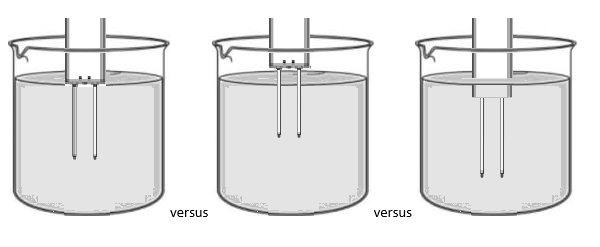
5. In the Settings Menu, press the arrow button to scroll to the “Clear User Calibration” option. Press the “Select” button twice to clear the user calibration.
6. Calibrate the meters in air and distilled water. Immersion of the probe in water should be the same as in step 4. Read our Calibration Article
7. Take 2 or 3 VWC readings with each meter. This is the most uniform condition you can create and the meter readings should be pretty close. The specification is +/- 3%. So, theoretically, they could be 6% different and still be within spec. But, typically, they will read closer.
Expected range of values in distilled water:
-
1.5”: 65 to 70%
-
3”: 75 to 80%
-
4.8”: 70 to 75%
-
8”: 60 to 65%
8. If the readings don’t seem close enough, re-do calibration with each meter.
The meters should be reading close to one another in distilled water. If not, change Moisture Type to “Period”. This is a raw sensor value. Take 2 or 3 readings with each probe. The expected value is dependent on the rod length.
If you want to collect some data that is more similar to a root zone, prepare a container of saturated sand. Dimensions the same as in step 5. The best way to create saturated sand is to put some water in the container first. Next, pour sand into the water until you get to the proper depth or you cannot add more sand without it being dry on top. In that case, put a little more water and add more sand. The advantage of adding sand to water rather than mixing in water is that it guarantees the sand will be saturated and have no air pockets. Take readings in the saturated sand with each meter.
The last thing you can try is to go to the field or course site. Pour a large amount of water on a small section of grass. This should minimize (but not eliminate) the spatial variability. The readings should be fairly close.